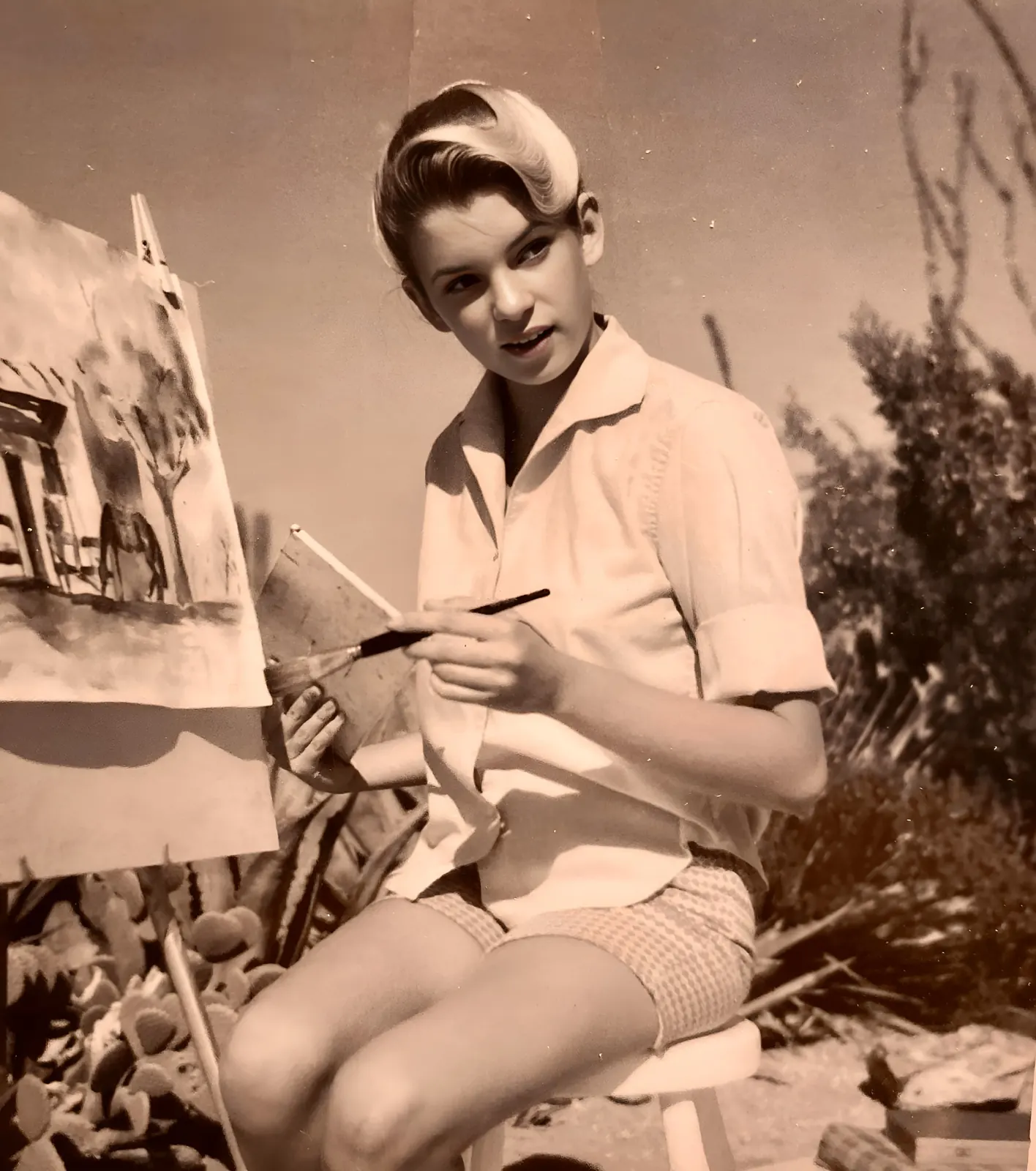
Her Story

Mary Jill Alice Roe Bennett

Some lives refuse to shrink into a single label. Mary Jill Alice Roe Bennett survives in the public record as an artist, writer, archaeological restoration specialist, researcher, and keeper of symbols, but what lingers even more strongly is the feeling of a vivid mind moving through desert light, ancient imagery, remembered roads, and a lifetime of making. This remembrance gathers those traces into a fuller whole.

Portrait of Mary Jill Alice Roe Bennett

Mary Jill Alice Roe Bennett is remembered here through her art, her writing, her public archive, and the places that shaped her imagination.

Pomona, Class of 1969The clearest academic marker ties her to Pomona and preserves the Saenz de Castillon connection that later opened into one of the deepest research threads on this site.
A Southwestern lifeTucson, Four Peaks, Monument Valley, Mt. Graham, Phoenix, and the Sonoran desert recur so often that geography becomes part of her signature.
Artist and restoration handHer public bio calls her an archaeological restoration artist, and the surviving works connect painting, reconstruction, historical study, and design into one body of work.
A voice that stayed publicThe 32 preserved articles, Blogger network, and MJA Studio traces keep her words and visual world alive long after scattered websites should have disappeared.

A Life Remembered

Mary Jill Alice Roe Bennett left behind a life that can still be felt in layers. Her full name anchors this memorial, but the public trail also carries the names Mary Alice Bennett and MJA Studio. Those are not separate stories. They are different doors into the same life: the woman who painted, researched, restored, wrote, questioned, remembered, and kept looking for patterns where other people might have seen only fragments.

The surviving record suggests a person who was never content with flat surfaces. She moved toward depth, toward what lay under the visible image, beneath the artifact, behind the story, beyond the official explanation. That instinct appears early in the academic anchor that places her at Pomona in the Class of 1969, and it remains visible much later in the essays, visual studies, and restoration work that spread across decades.

One of the most moving things about her record is how often place and memory arrive together. A first-person article remembers a spring-break trip out of Claremont toward Phoenix and Albuquerque in 1967. Another piece remembers Tucson and the late 1960s. A family detail survives in her own writing when she notes that her father worked as a test pilot for the aircraft industry. These are brief details, but they matter because they let the archive breathe. They remind the reader that behind every title and every preserved image there was a lived life, a daughter, a traveler, an observer, a mother, a human being moving through time.

That is why this biography is not only a list of credentials or surviving links. It is an attempt to hold together the intellectual life, the artistic life, and the personal atmosphere that still rises from the work she left behind.

The Shape Of Her World

The Southwest was not a backdrop in Mary Jill Alice Roe Bennett's work. It was part of her language. The names alone tell the story: Monument Valley Dream, Milcah above 4 Peaks, Blue Thunderbird Over Mt. Graham, Above 4 Peaks, Four Peaks Mountain, Phoenix Bird, and Mt. Lemmon Fire at North Sarnoff. Desert, mountain, fire, bird, horizon, and sky were not occasional motifs. They were recurring elements in the world she returned to again and again.

The public trail also places her in Tucson and preserves the older MJA Studio identity there. The Tucson record matters because it confirms what the paintings already suggest: this was a life rooted in the American Southwest, shaped by open distance, strong light, and the emotional charge of place. Even the 1975 Gentle Ben's design work speaks to an artist who moved comfortably between fine art, public visual design, and a local creative life.

Yet the Southwest was only one part of her geography. Ancient Mexico, Mesoamerica, Egypt, Ireland, southern France, Catalonia, and Renaissance Florence all entered her orbit. She seemed to approach the world as a network of charged places, each one holding memory, image, symbol, and unfinished questions.

Taken together, these places suggest not a collector of random subjects, but a person with a deeply coherent imagination: visual, historical, spiritual, and always alive to resonance.

Art Across The Years

The paintings, studies, and design work make the emotional record visible.

Titles and dates are only the frame. The deeper impression is of a life spent seeing intensely and translating that seeing into image after image across decades.

1966-1973

Early works such as Madonna in Red, Subconscious City, Space Dream, Monument Valley Dream, and Blue Thunderbird Over Mt. Graham show an imagination already moving between sacred image, dream logic, landscape, and visionary atmosphere.

Madonna in RedSpace DreamMonument Valley

1975-1982

The Tucson and Southwest years widen into public design and stronger regional imagery, from Gentle Ben's commissions to Orion Astronomer, Phoenix Bird, and the Four Peaks sequence. The work feels both local and mythic at once.

Gentle Ben'sOrion AstronomerPhoenix Bird

1999-2005

Later pieces such as St. George in an Eagle Helmet, The Zoo Painting with Aunt Cathie, The Tula Taxi, Dreaming Sung by Al Perry, and the Harpist cover design show that the work never hardened into a single mode. Curiosity stayed alive all the way through.

St. GeorgeThe Tula TaxiHarpist

Restoration, Study, And Ancient Worlds

Her public author bio describes her as an archaeological restoration artist living in the Sonoran desert near the border with Mexico, and that phrase is one of the keys to understanding her. It explains why her archive never separates painting from reconstruction, or research from visual intuition. In her world, making and recovering belonged together.

The restoration trail gives this part of her life real weight. Izapa Stela 5, the Jaguar Mural Teotihuacan, Nimrud restoration material, and related ancient-world reconstructions show a disciplined visual intelligence at work. These were not simply decorative interests. They were sustained engagements with damaged, distant, or half-lost things that needed patient seeing in order to return to view.

That restoration impulse feels central to her legacy. She did not merely admire the past. She worked to make it visible again. In that sense, the archive gathered on this site mirrors something essential about her own practice: careful preservation against loss.

A Writer With A Visual Mind

Under the name Mary Alice Bennett, a preserved UFO Digest author archive still holds 32 public articles. Their subjects range widely: Leonardo, King Tut, Maya imagery, relics, crop circles, Rennes-le-Chateau, anomalous experiences, southern-France symbolism, and historical mystery. The range is striking, but the voice behind it is even more striking. She wrote like someone who looked first, then kept looking.

Even when the subjects turned esoteric, her writing remained image-driven. Paintings, talismans, landscapes, towers, relics, sacred figures, sky events, and archaeological remains were never just data points. They were thresholds. She approached them as if they might still yield another layer of meaning if one stayed with them long enough.

The most intimate pieces matter especially. The remembered New Mexico trip, the Tucson childhood sighting, and the family details scattered through first-person writing give the archive an unmistakably human pulse. They let us hear her voice without mediation. They keep the memorial from becoming abstract.

What Endures

What survives of Mary Jill Alice Roe Bennett is more than a biography in the narrow sense. It is a field of presence. There are paintings filled with sky, desert, fire, saints, birds, mountains, and dreamlike architecture. There are restoration works that return damaged worlds to visibility. There are essays that cross from archaeology to symbolism, from history to intuition, from research to wonder. There are blog traces and studio traces that show how determined she was to keep her work and interests in motion.

The Blogger network active from 2008 into the later 2010s matters for this reason. It shows a woman continuing to gather, sort, preserve, connect, and re-present what mattered to her. The digital afterlife of her work was not accidental. It carries the same instinct visible in the restoration material: if something meaningful can still be seen, it should not be abandoned.

For those who knew her personally, the public record can only capture part of the truth. It cannot fully contain voice, humor, force of presence, or the private warmth of being loved by her. But it does preserve enough to make a powerful memory possible. It preserves a woman of vision, appetite for knowledge, artistic nerve, and unusual inner range.

She remains visible in the work because she put so much of herself into the work: the desert, the questions, the devotion to images, the hunger for meaning, the refusal to let mystery go flat. That is the memory this page hopes to leave with the reader.

The Record Behind This Remembrance

  • Pomona magazine preserves the clearest academic anchor and the public mention of the Saenz de Castillon Diary.
  • UFO Digest preserves the Mary Alice Bennett byline, the 32-article archive, and the author biography linking writing to archaeology, restoration, and the Sonoran desert.
  • The art timeline and works catalog preserve a dated body of work spanning paintings, design, restoration, collage, and later public traces.
  • Tucson and MJA Studio traces keep the studio identity, named works, and Southwest setting visible outside the family archive alone.
  • The Blogger network and related third-party pages extend her public presence through self-archiving, art preservation, and long-running research threads.

Keep Her Close

The best way to stay with Mary Jill Alice Roe Bennett is to move through the site the way her own life moved: from image to memory, from memory to place, from place to research, and from research back to image again.

Begin with the gallery if you want her visual language. Turn to the writings if you want her voice. Follow the timeline if you want chronology. Open the source library if you want the public record beneath the tribute.

However you enter, the lasting impression is the same: a woman of imagination, intelligence, and artistic force whose work still asks to be seen carefully.